
Simi sold fans. Good ones. Standing fans with metal blades, copper motors, and batteries that outlasted the unpredictable dance of NEPA. She knew her product. She believed in it. Yet the messages that landed in her inbox were not orders. They were interrogations.
“How many hours?”
“Is it noisy?”
“Does it come with warranty?”
“Why is this one more expensive than the other I saw?”
She would answer each one, patiently, individually, every day. The same questions, typed fresh each time, her fingers moving automatically, her spirit draining quietly. She was not selling fans. She was running a customer service hotline for a product she had already explained.
One afternoon, a woman came to her shop—a rare physical visit from an Instagram inquiry. She stood in front of the fan, touched the blade guard, read the box, then looked at Simi.
“The description online,” the woman said, “I did not understand what it really does. I had to come and see.”
Simi nodded, but inside, something cracked. A customer had travelled, spent transport money, taken time out of a working day, because the words on her page had failed. The fan worked. The price was fair. But the description was a wall, not a door.
That evening, she opened her phone and stared at her last post. A fan. A caption. A graveyard of vague effort.
“Premium standing fan. Durable and affordable. DM to order.”
It was not a lie. It was just useless.
She thought of the questions. All of them. Hundreds, preserved in her message archive like fossils of frustration. She had been treating them as interruptions. But they were not interruptions. They were a transcript of what buyers truly needed to know.
How many hours? — How long will this fan protect my sleep during outage?
Is it noisy? — Will it disturb my child studying?
Does it come with warranty? — If it spoils in two months, am I alone?
Why expensive? — Is this one of those that smell like burning after one week?
The questions were not about the fan. They were about fear. Fear of buying wrong. Fear of wasting money. Fear of being the one who chose badly.
She did not ask AI for poetry. She did not ask for hooks. She opened a blank page and wrote, not a caption, but a confession of what buyers were really asking.
Then she asked AI one thing: “Organise this into a clear product description. Keep it simple. No hype.”
It returned:
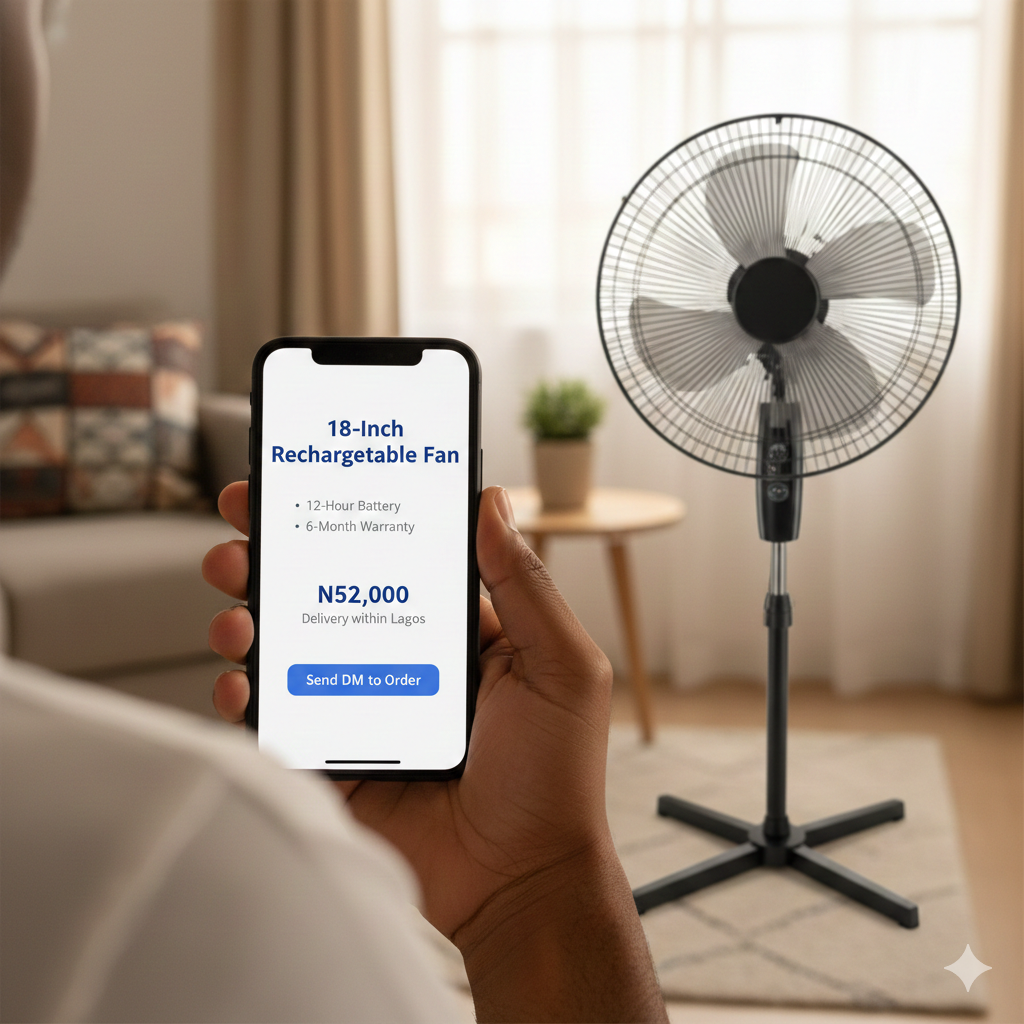
*Rechargeable Standing Fan – 18-Inch, 12-Hour Battery*
For families, students, and workers who need steady air through the night.
Full charge lasts through most power outages. Quiet enough for study or sleep. Copper motor for longer life.
*Tested before delivery. 6-month warranty included.*
Price: N52,000. Delivery available within Lagos. Send a DM to order.
She read it. It was not exciting. It was not emotional. It was not a performance. But it answered every question she had answered a thousand times. It named the user. It translated battery size into a real outcome. It addressed fear directly.
She replaced the old caption. Just one product. Just one post.
That week, the messages changed.
Instead of “How many hours?” they became “I need one, can you deliver to Ikeja?” Instead of “Is it noisy?” they became “Send your account number.”
She had not shouted. She had not begged. She had simply shown up with clarity instead of decoration.
The second shift came when she stopped writing from scratch.
One evening, tired, she pulled the working description and asked AI: “Turn this into a template I can reuse.”
It gave her a structure:
[Product Name + Key Benefit]
Who it is for
Main practical benefits (translated into daily life)
One risk reduction (warranty, testing, return policy)
Price + Delivery
Call to action
She saved it in her notes. Now, when new stock arrived, she did not panic. She did not stare at a blank screen. She filled in the blanks. Three minutes. Done. No anxiety. No delay.
The third shift was not about fans. It was about herself.
For years, Simi believed that selling required performance. That her words had to sparkle. That she had to convince, persuade, dazzle. But the fans taught her otherwise. Buyers did not want dazzle. They wanted safety. They wanted to know, before they sent money to a stranger, that what arrived would not let them down.
Her job was not to entertain. It was to reduce uncertainty.
She began applying the same structure to everything. Power banks. Blenders. Phone cases. The questions changed everywhere. The inbox grew quieter. The sales grew steadier. She was no longer an interpreter between product and buyer. She was a bridge.
One evening, a message arrived from a woman she had never met. It said simply: “Your description was so clear. I knew exactly what I was getting. Thank you.”
Simi sat in the quiet of her room, phone in hand, and felt something she had not felt in months. Not exhaustion. Not anxiety. Just the calm of being understood.
She had stopped trying to impress. She had started trying to help. And helping, it turned out, was the most effective sales strategy of all.
Buyers do not need your creativity. They need your clarity. The difference between a product that sells and one that sits is not the price. It is how quickly the buyer can answer: “Is this for me, and can I trust it?”
The method for building that bridge is here: